
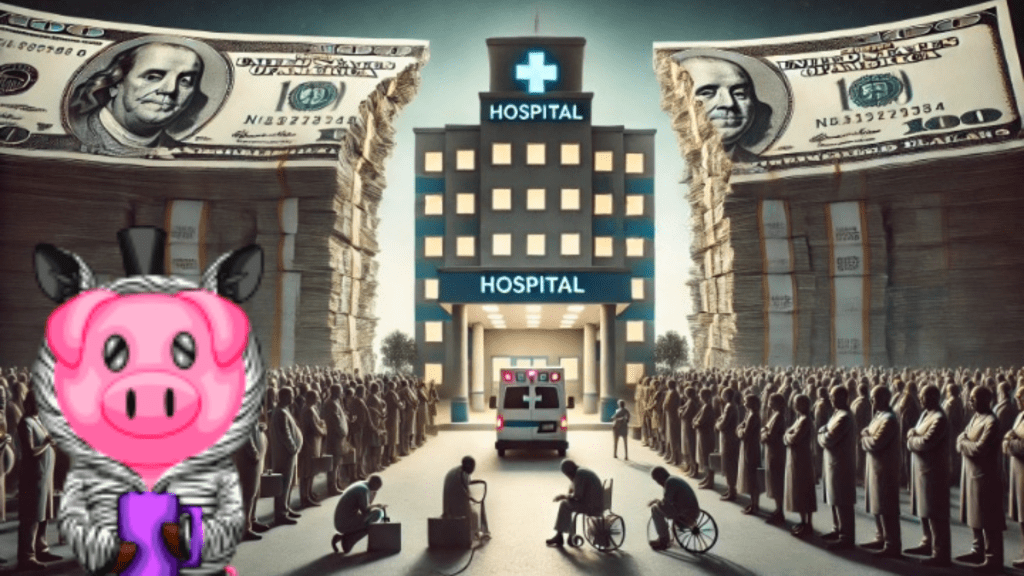
Hello Dazzle! Thanks for coming and hanging out with me today, I’m glad that you are here. Today I’m going to be talking about something really important—the state of health care in America. It’s no secret that our health care system is broken, and it affects millions of people every day. Whether you’ve struggled with medical bills, insurance problems, or just getting access to the care you need, this is a topic that hits home for so many of us. So let’s break down exactly what’s going on and why we need change.
1. Costs and Spending
Let’s start with the money, because America spends a lot on health care—more than any other country in the world. On average, the U.S. spends nearly $12,318 per person on health care each year, but what’s shocking is how little we get in return for all that spending. For many people, high costs lead to financial disaster. Did you know that 62% of bankruptcies in the U.S. are linked to medical debt? That’s heartbreaking, and it shows how dangerous medical costs can be, even for people with insurance.
For those earning minimum wage (about $1,256 a month), just paying for health insurance premiums can eat up 15-20% of their income. And that’s without considering co-pays, deductibles, or the cost of medications. Health care shouldn’t be this expensive—especially in a country with so many resources.
2. Quality of Care
So, with all that spending, you’d think we’d have the best health care in the world, right? Not so much. In fact, the U.S. ranks 11th out of 11 high-income countries when it comes to health care quality, according to the Commonwealth Fund. We fall behind on key indicators like life expectancy, infant mortality, and managing chronic diseases. Countries like Australia, the UK, and Japan—where health care systems aren’t driven by profit—consistently outperform us. It’s frustrating to think that all this money still leaves millions of people with subpar care.
3. Access to Care
The thing about health care in America is that not everyone can even get the care they need. If you have a well-paying job with benefits, you might not feel this struggle, but for millions of others, especially those in lower-income brackets or rural areas, health care is often out of reach. Clinics are understaffed, wait times are long, and many rural hospitals are shutting down. It’s especially tough in rural communities, where patients might have to drive for hours just to get to the nearest hospital or specialist.
4. The Uninsured
Even more concerning is the number of people who simply don’t have health insurance at all. In 2022, 27.5 million Americans were uninsured. These are people who fall into a gap—they make too much to qualify for Medicaid, but they can’t afford marketplace insurance plans either. Without insurance, many avoid getting medical help, which can lead to untreated conditions and even more expensive emergency care down the road. It’s a vicious cycle.
5. Why Is American Health Care So Broken?
One of the biggest issues in our system is that it’s profit-driven. Hospitals, insurance companies, and pharmaceutical companies operate like businesses, which means their top priority is making money. When profit is the goal, care often takes a backseat. This can lead to inflated costs, unnecessary procedures, and a system where doctors are pressured to see as many patients as possible in a short amount of time.
For example, in the U.S., the average cost of an MRI is around $1,119, but in Australia, the same scan costs just $215. Why? Because our system is set up to prioritize profits over patient well-being.
6. What Are the Solutions?
Fixing this system won’t be easy, but there are some clear steps we can take. Many experts suggest moving toward a universal health care system, where everyone has access to basic care regardless of income. Countries with universal health care, like Canada and Germany, spend less money and still get better outcomes. By cutting out the profit motive, we could focus more on patient care and less on padding the pockets of insurance executives.
We could also regulate drug prices, increase transparency in hospital billing, and expand Medicaid to cover more low-income Americans. Another big improvement would be investing more in preventive care so people stay healthier and avoid expensive hospital visits.
7. Moving Forward
It’s clear that we have a lot of work to do. But talking about these issues is the first step toward change. We can push for a system that puts people over profits and makes sure that everyone has access to the care they need without fear of financial ruin.
Well, that’s about it for my rambling today. Thanks for coming and spending some time with me. If you like my rambling then click on that like button. It really does help! Until we talk again, you take care of yourselves!



 Zebra Pig
Leave a comment