
Hello Dazzle! Thanks for coming and hanging out with me today, I’m glad that you are here. Back in March, I posted a blog titled “I’ve Been Struggling.” I shared that with you because I feel that it is important to talk about the rain and clouds in our lives. It is all too easy to filter our social media to include only the sunshine and rainbows, but I feel like this is a disservice to everyone. It creates this illusion that those who are having mental health struggles are alone in those struggles when that just isn’t the case. “It is estimated that more than one in five U.S. adults live with a mental illness (57.8 million in 2021).” [1] Which means that having mental health struggles is a common human experience.
I have experienced trauma as a nurse that I am working to recover from and that takes time. It has been three months and I am doing a check in now; with you and myself. While on a recovery journey it is a good idea to have a check in at scheduled intervals to see where you are at in the process. This allows you to see what progress you’ve made and it gives you a chance to evaluate the interventions that you’re using. I am personally using the Depression Spectrum Test every 3 months to assess my symptoms.
Why am I using this measure? My trauma symptoms are mostly presenting themselves as depression symptoms which makes this particular tool a great way for me to track how my symptoms are doing. Using a tool like this ones gives you a way to measure and assess your symptoms. If you use the tool at scheduled intervals it can give you insight as to how your symptoms are progressing over time. The last thing is that it can offer a bit of an outside perspective. This might seem counter intuitive since you are the one giving the tool the data. But the questions are designed to look at specific areas of symptom sets and then it presents the information in a way that allows you to consider your symptoms in a way you normally wouldn’t.
Before using the tool, I personally write about how I feel things have been going. This helps me gather my thoughts and think about how things have been before answering the questions in the tool. It also helps me consider what my current perception of my symptoms is before using the tool. I personally find it interesting to compare what I see before and after using the tool.
This time around, I felt that my symptoms had improved and that I was doing better. I based this on the fact that I have not been feeling as dejected or hopeless as I was previously. This seemed like a huge improvement to me. I feel that this came about as a direct result of the interventions that I have been using. I have been giving my self a huge amount of emotional space. Every night I have been doing an emotional inventory. I just ask myself how I am feeling and allow myself to feel whatever it is that comes up. The result was that I have been spending a lot of nights sobbing into May and writing furiously into my journal. But I feel that allowing myself the time to process these feelings has allowed me to work through them and get past them.
Then I took the Depression Spectrum Test. And I was surprised by the results. I think it will be more useful if I show you March’s results for comparison, because it’s that comparison that surprised me. So let’s look at the results for March and June side by side.
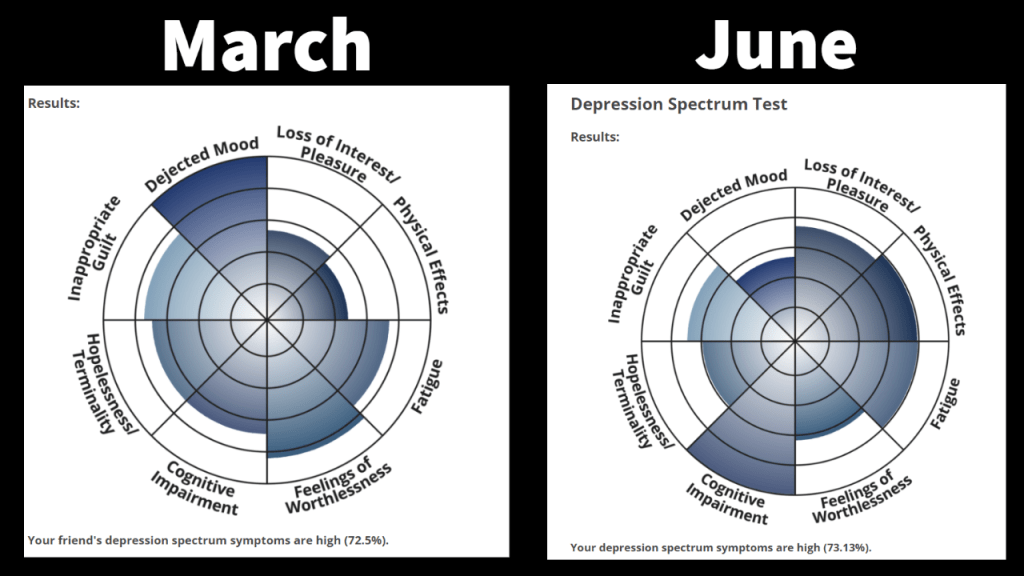
What I discovered was that I was right and wrong at the same time. I think this is a great example of how our symptoms fluctuate and shift over time while remaining the same severity. Presentation changed a lot between these two assessments, but the overall score is about the same (72.5% vs 73.13%). Looking at the individual symptoms, my perception was correct. I did have a reduction in Dejected Mood (2.5 vs 5). My sense of hopelessness is also down a little bit (3 vs 3.5). My Feelings of Worthlessness were also down (3.1 vs 4.1). What I hadn’t considered was how my other symptoms were doing. I was feeling the same amount of Inappropriate Guilt (3.5). There were also symptoms that had increased: Cognitive Impairment (5 vs 3.5), Fatigue (4 vs 3.5), Physical Effects (4 vs 2.5) and Loss of Interest / Pleasure (3.5 vs 2.5).
Why am I telling you all this? I wanted you to see the way that mental health symptoms fluctuate over time and how different we can present while we are still struggling with the same severity. I wanted to shine a light on the complexity of how there is so much more to mental health struggles then just how we are emotionally. Our mind is a part of our body and our emotions cannot be generated without using resources from that body. This means that as we do the work of healing we will often cycling into periods of having physical symptoms. This is because processing all of that emotional stuff comes with a metabolic cost. Our emotions are not just ephemeral fluff. They are part of our biology and because of that they have an impact upon our biology.
For me, all this means that I need to continue to work on my healing journey. In this quarter of healing, I will put my focus on allowing myself to rest and engaging in activities that restore my spoons. Because of that, I have done an evaluation of my schedule and there have been adjustments made. One of them is that the posts for this blog will now be published on Thursdays. I’ve updated my schedule to include more of my social media activity so that you and I can see what is happening more easily. You can see that schedule over here: Zebra Pig’s Schedule.
Well, that’s about it for my rambling today. Thanks for coming and spending some time with me. If you like what you read, click on that like button. It really does help! Until we talk again, you take care of yourselves!





Leave a reply to Mental Health Check In – Zebra Pig Cancel reply